


Sustainability is not a cost, but a competitive advantage
Sustainability has become one of the most overused buzzwords in the industry in recent years, but few companies can say that they have been operating in accordance with this principle for decades. Prysmian, which has been manufacturing cables in Keila for nearly 60 years, sees environmental awareness as a strength that helps increase efficiency, reduce waste, and remain competitive in the international market.
"It is often feared that sustainability means only more expensive solutions and more restrictions. In reality, it adds efficiency to production and improves competitiveness from both a reputational and commercial perspective," says Tarvo Leppik, Sales Director at Prysmian Baltics. "European industry is moving in this direction very quickly, and if we did not keep up with these topics, we would soon no longer be able to compete."
Cables have been produced in Keila since 1968, and, according to Leppik, the company's long-term operation also clearly demonstrates that sustainability is not only about the environment, but also about people and work culture. The plant employs people whose length of service spans decades. This shows that the company has created an environment in which people want to work and develop.
Prysmian was one of the first Estonian companies to achieve the ISO 9001 quality management certification. Later, the ISO 14001 environmental management standard and ISO 45001 occupational health and safety certificates were added. The company has also been repeatedly recognised with the Gold Level of the Responsible Business Forum, most recently in 2023 and 2025. "We haven't acquired these certificates just to tick a box; they help to systematically improve the entire organisation," says Leppik. "When you monitor your processes, energy consumption, waste, and occupational safety thoughtfully, the entire production ultimately becomes more efficient."
Today, the Keila plant has been using carbon-neutral electricity, derived entirely from renewable energy sources, for nearly ten years. 90% of the building's heating comes from renewable energy, and the remaining diesel forklifts are gradually being replaced with electric ones. The Prysmian Group's goal is to achieve carbon neutrality by 2035, and the Keila plant is currently moving towards it faster than the average of our 110 factories.
Less material, same quality
One of the most important sustainability directions for Prysmian is product development. In cable manufacturing, this means a constant question of how to use less material and more environmentally friendly solutions while maintaining all safety and quality requirements. "A cable does not necessarily have to be a perfectly round shape just to look visually appealing," explains Raigo Viltrop, Product Manager for the Construction Segment at Prysmian Baltics. "Historically, standards have been very conservative, and this often meant that more plastic had to be put into the cable, even though it added no value electrically. Today, with the increase in the quality of raw materials and processes, we are trying to change these principles and find more sustainable solutions."
As an example, he points out the changes in the construction of the XPJ HF-D cable, which reduced the use of plastic. Copper makes up about 60 percent of the cable's mass, and plastic makes up a large part of the rest. That is exactly where the opportunity to reduce environmental impact is seen. In addition, for some 1 kV power and underground cables, there has been a transition to materials that can be more easily recycled later.
"Modern electrical networks still use many materials that cannot be efficiently recycled after use," says Viltrop. "The entire European industry is actively looking for solutions to make cables more recyclable in the future. We already use a significant amount of recycled materials in the outer sheaths of our cables today. We use 1,200 tons of recycled plastic materials annually to manufacture our products – this means that we reduce the use of virgin materials by the same amount and avoid landfilling waste. The goal is to keep as much material as possible genuinely in circulation."
Sustainability is already affecting public procurement
According to Prysmian, sustainability will become an increasingly important competitive factor for the entire industrial sector in the coming years. This is also demonstrated by changes in Baltic public procurements. Recently, the Lithuanian distribution network ESO introduced clear sustainability requirements into a public procurement for the first time in the Baltic States, where, in addition to price, the carbon footprint of the products, the origin of the materials, and recycling were also evaluated. According to Tarvo Leppik, this is a sign that the market has reached a new stage. "For years, it was said that environmental impact could be evaluated in addition to price, but now it is actually happening," he says. "In Western Europe, this has been commonplace for quite some time, and the Baltics are moving in the same direction."
Environmental Product Declarations (EPDs) have also become an important topic, allowing the carbon footprint of a cable to be calculated throughout its entire life cycle. Today, Prysmian is already able to provide clients with detailed information about the environmental impact of its products. "While previously the focus was mainly on price and technical specifications, today partners also want to know what the product is made of, where the material comes from, and what happens to it after use," explains Viltrop.
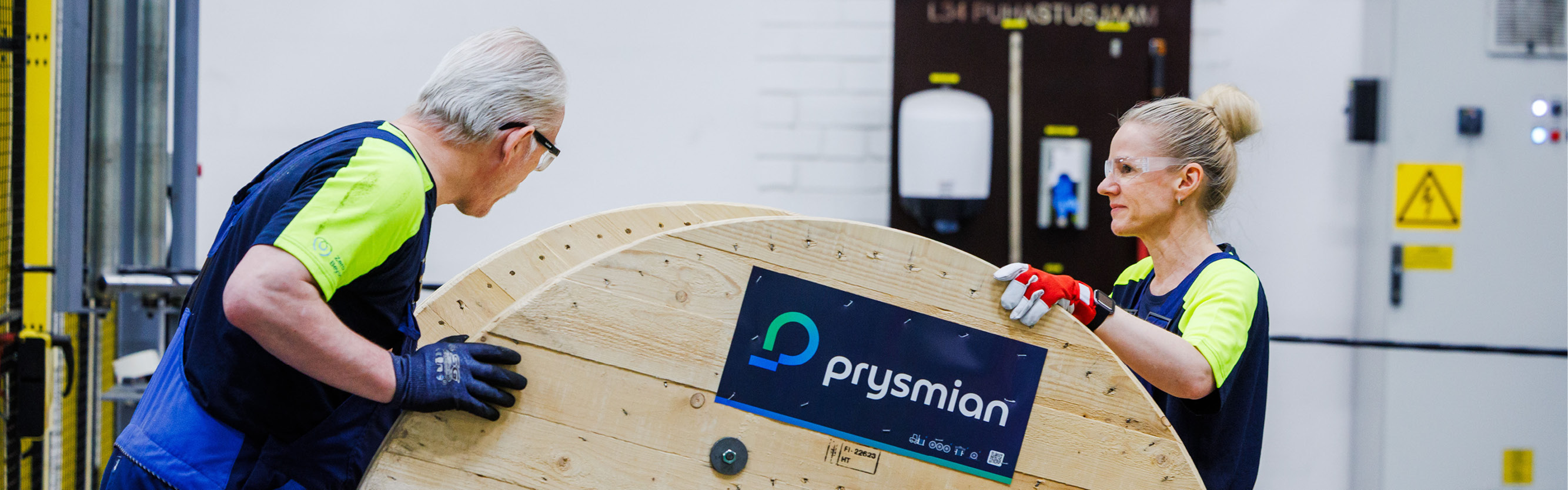
According to the company, sustainability also involves logistics and packaging. Prysmian's wooden cable drums are fully traceable and are used repeatedly. The wood for the drums is sourced from certified sustainable forestry, and the company's goal is to keep the drums in circulation for as long as possible. "The more drums are reused, the less need there is to cut down forests," says Leppik. "If a client values sustainability, they also appreciate that the packaging does not become waste after a single use."
In addition to the environment, Prysmian also considers occupational safety and diversity to be important. In a traditionally masculine industrial sector, the company has consciously moved towards greater balance so that, today, more and more women work in the plant and office. According to Leppik, a wider pool of talent means a stronger company, because a more diverse work environment makes the entire organisation more caring and attentive.
Sustainability has long been a part of everyday management and product development for Prysmian. "Have we gone too far? We do not think so. On the contrary – it helps to save resources, makes production more efficient, and drives innovation," says Leppik. "This is a win-win situation for the company, employees, clients, and society as a whole."
The Keila manufacturing plant belongs to Prysmian, the world's leading energy and telecom cable systems group. The company serves both local and foreign markets and is part of an international network operating in over 50 countries, combining the expertise of over 100 factories and 27 research and development centres. Prysmian develops and manufactures cable solutions for the energy and telecommunications sectors, ranging from electrical grids and infrastructure to high-speed data connections.
The article was published in the magazine Eesti Tööstus.