


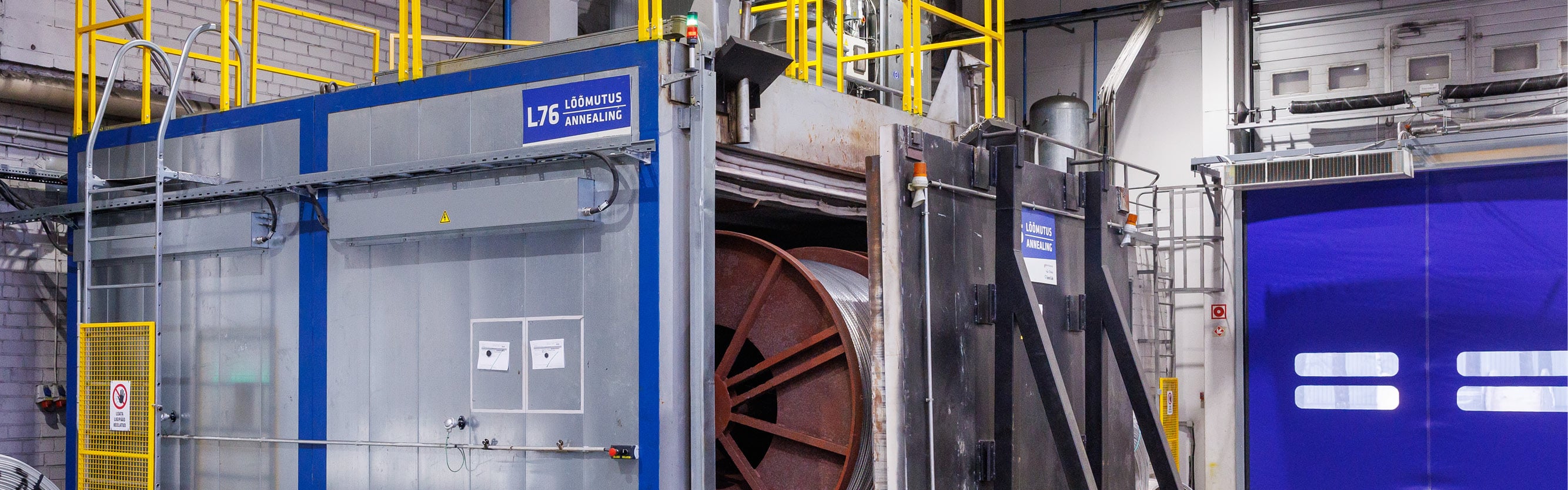
Why does one cable bend and the other doesn’t? The answer lies in the annealing
When it comes to cables, people tend to look at the cross-section, insulation, current-carrying capacity and other technical specifications, but one important attribute may go unnoticed, as it cannot be assessed by appearance alone. This is the annealing, or heat treatment, of the cable core, which directly affects the flexibility of the cable during installation.
The purpose of annealing is to make the metal softer and more ductile after processing. As a result, it is easier to bend the cables into the desired position, and once bent, the cable does not try as vigorously to spring back to its original position. “If the cable core has not been properly annealed, it is considerably more difficult to bend. At the same time, there is an increased risk of unwanted mechanical stress occurring at the connection," explains Raigo Viltrop, Product Manager for the Construction Segment at Prysmian Baltics.
The problem becomes apparent in distribution cabinets, substations and connection centres, where cable installation space is limited. A stiff cable does not stay in the desired position, but behaves like a spring, trying to straighten after being bent. This increases the strain on the terminals and connections. “Annealed cable makes the installer’s job easier and the result more predictable. The cable is more flexible," says Viltrop.
Annealing is a metallurgical process in which the material is rapidly heated to the required temperature and then cooled slowly and in a controlled manner. As a result, the internal stress in the metal is reduced and it becomes more ductile. At the Prysmian Group Baltics plant in Keila, cables are annealed in special furnaces. There are several furnaces at the factory, the largest of which has a capacity of 540 kilowatts. One of the furnaces is airtight and is used, amongst other things, for annealing copper. As heated copper would react with the air, oxidise and turn dark, the furnace is filled with nitrogen during the process.
At the same time, cable annealing is a rather energy-intensive and slow process. To do this, the entire section of cable must be placed in the furnace, heated to a temperature of approximately 400 degrees, and then allowed to cool slowly and in a controlled manner. Annealing the entire cable essentially takes 24 hours.
Wires can also be annealed during the drawing process, and this method is widely used as it is considerably quicker. Viltrop states, however, that annealing of individual wires may not provide the desired result. “If the annealed wires are subsequently twisted and shaped together, the internal stress of the material will re-emerge and some of the desired ductility may be lost. It is therefore important to assess the annealing in the context of the finished cable as a whole.”
An idea that originated in Estonia was put through more detailed testing in Lithuania
In the Nordic countries, electricity networks require that underground cables that have an aluminium core must be annealed, but there are no specific measurement criteria laid down. Consequently, it is difficult for the supervisory authorities to verify compliance, and they must rely on the manufacturer’s declaration. To resolve the issue, Elektrilevi in Estonia drew up a test procedure to measure the extent to which a bent cable returns to its original shape. Although this is not a standardised test method, the test procedure is straightforward and provides a good indication of adequate annealing.
In Lithuania the experiments carried out in Estonia were developed further. Mindaugas Liaugminas, a representative of Prysmian in Lithuania, explains that the aim was to establish a method for determining annealing based on specific standardised parameters, so that no party would have any doubts regarding the interpretation of the data.
“In Lithuania, the transmission system operator ESO has laid down specific technical requirements for annealed aluminium conductors in order to avoid situations where the manufacturer and the transmission system operator interpret the presence of annealing differently. We realised that the requirement needed standardisation so that everyone would have the same understanding of what an annealed cable is," says Liaugminas. According to him, a problem can also arise when two cables look exactly the same on the outside. The actual level of annealing may not be visible, and after the rods have been twisted and shaped, any discrepancies may only become apparent during installation.
How can one measure an invisible property?
To assess annealing, both practical bending tests and standardised mechanical tests can be used. For example, according to Elektrilevi’s guideline P270, the annealing of a conductor can be assessed by bending it to 90 degrees, then releasing it and measuring to what extent the conductor returns to its original position. The greater the amount of return, it indicates, the higher the residual stress. In the test, a conductor is deemed to comply with the requirement if the measured return angle of all its grooves is less than 20 degrees. Another option is to assess the tensile strength and elongation of aluminium wire. The standard EN/IEC 62641:2022 addresses the mechanical properties of aluminium and aluminium alloy wires used in electrical conductors, and also provides the means to assess the properties of annealed aluminium. These values are determined in the laboratory using specialised equipment.
Tests carried out at the Prysmian plant in Keila confirm the suitability of the previous methods. While the standard elongation of annealed wire must be at least 20 per cent, in the case of annealed wire this was clearly above that, and in the case of unannealed wire the elongation was only around 3 per cent. Also in the Elektrilevi’s guideline, the 20 degree return mentioned in the bending test was not a problem for the annealed conductor, and the unannealed wire exceeded this by nearly double.
In practice, the first indication can be obtained by the installer’s experience. If the cable is unusually stiff or tends to spring back to its original position after being bent, it is worth having a closer look at its properties.
In Estonia and Lithuania there have been discussions about how to describe the annealing requirement in more detail. While Estonia has chosen to develop its own guidelines, Lithuania has established specific standard requirements. “Although the approach is slightly different, the aim is the same – to determine a specific measurement value and thereby ensure the longevity of electrical connections,” comments Liaugminas.
Article from ehitusuudised.ee