


6 things you should know when choosing a cable
Although the cables appear very similar, they differ significantly in their construction and the materials used, which in turn imposes restrictions on the environments for which they are suited.
Standing in front of a shelf of cables, you might wonder why products that look so similar are priced so differently. Although electrical work should only be performed by trained specialists, people often try to do smaller jobs themselves. Making an informed choice when selecting cables helps avoid risks and ensures system reliability for years to come.
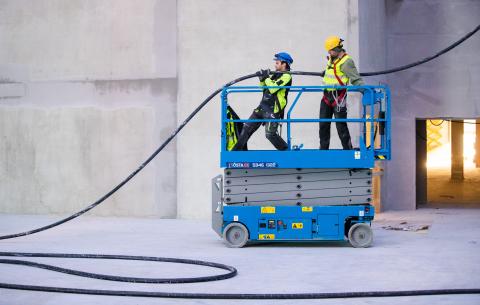
Although the cables appear very similar, they differ significantly in their construction and the materials used, which in turn imposes restrictions on the environments for which they are suited.
1. Electrical safety is a real issue
Last year, more than a third of residential fires were related to electricity. In half of those cases, the fire was caused by a fault in the electrical installation. If electrical system components are selected and installation is done by the user, the suitability and reliability of the materials may not be guaranteed.
2. Installation cables (XPJ, XPUJ) are primarily suitable for buildings
Installation cables with a rated voltage of up to 750 V are intended for use inside buildings and at the end of electrical circuits. The most common types are XPJ and XPUJ with a black outer sheath, as well as their halogen-free versions. Although they withstand moisture and temperature fluctuations - and XPUJ also resists UV radiation - they must not be subjected to physical stress or be installed underground.
3. Outdoor use requires additional protection
When installation cables are used outdoors, it is important to ensure that the selected product is suitable for the intended purpose. It is recommended to use additional protection, such as a protective conduit. In any case, underground installation must be avoided.
4. Not all black cables are suitable for outdoor use
Power cables with a rated voltage of 1 kV are intended for larger equipment and the main circuits of a building's electrical system. Nowadays, halogen-free cables are required in buildings (e.g. N2XH, Prysmian XPK-HF C-Pro), as these do not spread fire or emit much smoke. Even though they are black and have a voltage class of 1 kV, they are not suitable for underground installation.
5. Choose a suitable cable for underground installation
XPK cables with a PVC sheath or AXPK cables with aluminium conductors and a PE sheath are suitable for underground installation. These have a more robust construction and are more resistant to external factors.
6. The safest choice is a cable with a concentric protective earth conductor
An even safer solution, suitable for both buildings and underground applications, is a cable of type MCMK with copper conductors or AMCMK with aluminium conductors. In addition to the PVC outer sheath, these types of cables are also available as halogen-free Dca and Cca CPR class. They have a concentric protective earth conductor, which increases the likelihood that, in the event of an insulation failure, a connection with the protective earth conductor will be established and protective devices will trip the circuit. This significantly reduces the risk of fire and electric shock.
| Cable type | Rated voltage | Suitability for buildings | Suitability for underground use | Notes |
| XPJ / XPUJ | up to 750 V | Yes | No | Installation cables for circuit terminations. XPUJ is UV-resistant. Requires conduit for outdoor use. |
| N2XH / XPK-HF C-Pro | 1 kV | Yes | No | Halogen-free, flame retardant. Intended for main circuits. Not suitable for underground use despite being black. |
| XPK / AXPK | 1 kV | No* | Yes | Robust construction. XPK has copper conductors, AXPK has aluminium conductors. |
| MCMK / AMCMK | 1 kV | Yes | Yes | The safest choice. The concentric protective earth conductor ensures rapid fault current interruption. |
*Inside buildings (especially public buildings), halogen-free cables (e.g. N2XH) are preferred, whereas XPK has a PVC sheath.
Find out more in our online catalogue.