



Prysmian and Onninen are piloting a return scheme for plastic cable drums
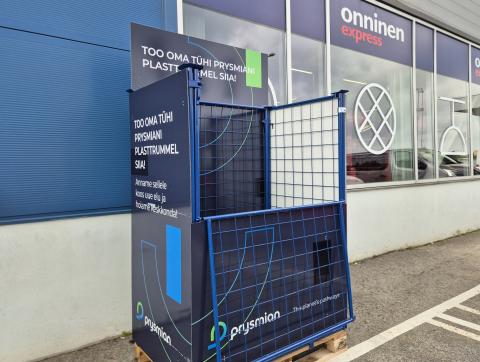
In addition to construction waste, construction sites generate significant quantities of packaging materials, the recycling of which has not yet been carried out in a particularly systematic manner. Cable manufacturer Prysmian and electrical materials wholesaler Onninen have launched a pilot project aimed at reintroducing plastic cable drums into circulation and reducing the volume of waste generated on construction sites.
For Prysmian, returning cable drums is not a new idea. The return of wooden drums has been operating successfully within the company for many years, and their circulation has become a standard part of the supply chain. It is now proposed that the same principle be applied to plastic drums, which currently account for a smaller proportion of the total but are in ever-increasing use.
Jarmo Peterson, Estonian Sales Manager at Prysmian, says that the problem is not so much the quantity of drums as the fact that, once the cable has been laid, they often simply end up as waste on the construction site. "It’s easier to throw them into a construction waste bin, although they should actually be sorted separately. On a building site, this is often the last thing people think about. Our aim is to ensure that used drums do not end up in some corner of a site or under a bush, but are returned to the manufacturer."
However, plastic drums do have their own limitations. Whilst a wooden drum can be repaired if necessary, a plastic drum must be in good condition. "As soon as a drum is even slightly damaged, it’s rubbish as far as we’re concerned, but we take responsibility for it ourselves," says Peterson.
The idea arose from a joint discussion between the manufacturer and the Distributor
Kairi Kitsing, Procurement Director at Onninen, states that the idea of returning plastic cable drums arose during a joint discussion between the companies that covered both reducing the carbon footprint and how to apply the principles of the circular economy in a practical way. "Cables supplied on plastic drums have become increasingly common on construction sites, and as a result, more plastic waste is being generated." This raised the question of whether these drums could be reused in the same way as wooden cable drums, the return of which is something Prysmian has long-standing experience with."
At Prysmian’s Keila plant, the return rate for wooden drums is already over 80 per cent, and a wooden cable drum can be reused on average up to eight times. However, according to Peterson, the service life of plastic and metal drums may be even longer. "This initiative also solves a practical problem for customers, as plastic drums are a bulky type of waste, the handling of which often entails additional costs and logistical challenges. From the perspective of the circular economy, it is important that these do not end up in mixed waste."
According to the European Commission, construction and demolition waste accounts for over a third of the total volume of waste generated in the European Union, making it one of the largest waste streams. In addition to concrete and other building materials, construction sites generate significant quantities of timber, metal, plastic and various packaging materials. From the point of view of material reuse, the key issue is the separate collection of materials, as once they end up in mixed waste, the potential for reuse and recycling is significantly reduced.
Although the recycling rate for construction waste in Estonia is high, a large proportion of this consists of mineral materials such as concrete, bricks and soil. According to data from the Environment Agency, 39 per cent of construction and demolition waste was recycled as material in 2021, with metals being the most successfully recycled. This shows that there is still scope for improvement, particularly in the reuse of packaging and other materials. For this reason, returning plastic cable drums is also a practical way of reducing waste and keeping materials in circulation for longer.
Responsibility means taking practical action, not just setting goals
"For Onninen, responsibility means, above all, helping our customers make more energy-efficient and environmentally friendly choices, and applying the same principles to our own operations. Renewable energy, energy storage and electrification solutions play a key role in our product range, including solar power plants, energy storage systems, electric vehicle charging infrastructure and energy-efficient heating, ventilation and cooling systems,” says Kitsing. She adds that, at the same time, responsibility is not limited solely to products. "We are constantly looking for ways to reduce waste, improve the efficiency of our logistics and increase the reuse of materials. The plastic cable drum return scheme is a good example of how to reduce environmental impact.”
If the customer is able to return the drums, the material is sent on for reuse or recycling. This means that less waste is generated on the building site and valuable materials remain in use for longer. A pilot project is currently underway, the success of which will be assessed on the basis of the number of drums returned. According to Peterson and Kitsing, it is important to understand whether customers are ready to adopt the new solution. “We want to see how much people care about this. If returning items becomes as natural as it is with wooden cable drums, then the objective will have been achieved."
If the pilot project proves its worth from both a customer and a logistics perspective, the return of plastic cable drums could become standard practice in the construction sector. This would be a practical step towards reducing waste and keeping valuable materials in circulation for longer.
Article from elektriala.ee