


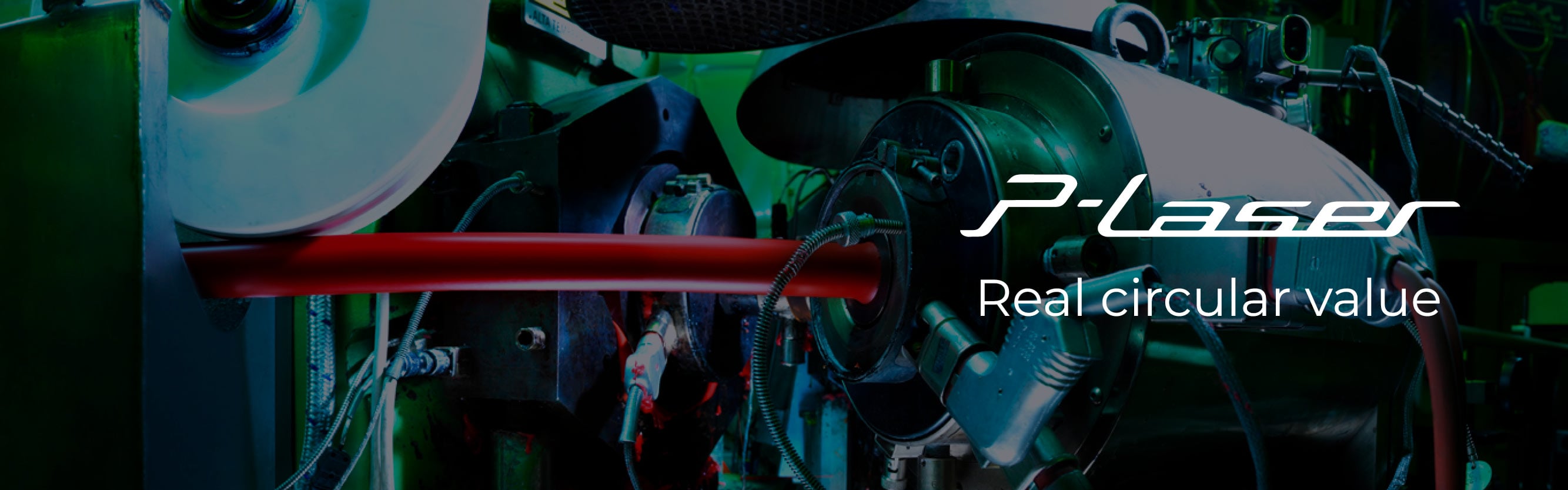
P-Laser reduces the environmental impact of cable manufacturing and improves recyclability
In the development of power grids, increasing attention is being paid to the environmental impact of materials throughout their entire lifecycle. Prysmian has introduced P-Laser – a breakthrough cable technology centred around the thermoplastic insulation material PP-TPE.
P-Laser is a Prysmian trademark representing PP-TPE (Polypropylene Thermoplastic Elastomer), a standardised thermoplastic insulation material. “Thermoplastics combine great flexibility, strong thermo-mechanical properties and excellent electrical performance, making it possible to reduce the environmental footprint of cable manufacturing while enhancing recyclability,” says Raigo Viltrop, Product Manager for the Construction Segment at Prysmian Baltics. “Unlike the widely used cross-linked polyethylene (XLPE), it can be easily recycled at the end of the cable's service life.”
Erkki Keerig, Chief Engineer at Prysmian Baltics, explains that heating traditional insulation causes a chemical reaction, resulting in a molecular structure that can no longer be melted down and remoulded into a new product. Thermoplastics behave differently: they melt when heated, and upon cooling, their original electrical and mechanical properties are fully restored.
Prysmian began developing recyclable insulation materials more than 20 years ago. The development of P-Laser technology was launched in 2003 at the company's R&D centre in Milan, and the first prototype was completed in 2005. The goal was to find an eco-friendly alternative to XLPE that could be fully recycled after use.
Lower environmental impact and greater flexibility
P-Laser differs from traditional materials in both its recyclability and manufacturing process. Because PP-TPE does not require cross-linking, cable manufacturing consumes significantly less energy, resulting in a smaller CO₂ footprint. “The whole process is more energy-efficient, and the production process for medium- and high-voltage cables is also faster when using this material,” emphasises Keerig. “So we are not just talking about recycling at a later stage; reducing the environmental impact begins right from the production stage.”
The P-Laser also has characteristics that affect the cable’s use in the grid. One key difference, according to Keerig, is that P-Laser’s operating temperature is not limited like that of conventional insulation. Because the material lacks chemical bonds that break down under extreme heat, the cable can withstand temporary overloads during emergency situations, allowing temperatures to safely rise above standard operational limits.
P-Laser was initially developed for medium-voltage cables, where thicker insulation layers yield a greater environmental and operational impact. In 2011, the product portfolio was expanded to cover up to 30 kV for wind energy projects. By 2019, P-Laser production volume had reached 50,000 kilometres, and in 2023, the HD 620 S3 standard was published, officially incorporating a new section covering PP-TPE.
Viltrop notes that this technology, which began in medium-voltage applications, has now made its way to low-voltage systems. “For low-voltage cables, the material savings are not as massive as in medium-voltage lines, but it still allows us to deliver significantly more sustainable solutions.”
P-Laser cables at the Keila plant are currently produced exclusively for export
P-Laser technology is deployed across multiple markets – including Italy, the Netherlands, and Norway – and its portfolio continues to expand. A few years ago, the technology entered the Swedish market. “Norway is a key target market for us, as sustainability is given top priority there. "Currently, we produce P-Laser cables in Keila primarily for international markets, as there are no active projects utilising this material in Estonia at the moment," says Viltrop.
For Prysmian, P-Laser serves as a prime example of aligning cable technology advancement with a reduced environmental footprint and a circular economy. “Our goal isn't to treat sustainability as a separate project, but to weave it directly into product development,” emphasises Keerig. “P-Laser allows us to simultaneously improve material recyclability, reduce manufacturing energy consumption, and enhance the cable’s operational flexibility.”
One of the most important sustainability directions for Prysmian is product development. In cable manufacturing, this means continuously evaluating how to use materials more efficiently and find greener solutions – all while maintaining the highest safety and quality standards.
The Keila manufacturing plant belongs to Prysmian, the world's leading energy and telecom cable systems group. The company serves both local and foreign markets and is part of an international network operating in over 50 countries, combining the expertise of over 100 factories and 27 research and development centres. Prysmian develops and manufactures cable solutions for the energy and telecommunications sectors, ranging from electrical grids and infrastructure to high-speed data connections.
Article from elektriala.ee